


Around 5 million people in the UK suffer from various levels of asthma and for people with this condition, air quality can be an important factor in their quality of life. This was a reality for Jacques Touillon, whose son suffered from asthma. Back in 2014, he started a successful Indiegogo crowdfunding campaign for an indoor air quality monitor called Foobot (formerly Alima) and now the Foobot is available for sale in North America, Europe and Australia. Let’s take a look.

- VOCs – Volatile Organic Compounds, which are toxic gases like ammonia and formaldehyde
- PM2.5s – Particulate Matter smaller than 2.5 micrometres, like dust, pollen and pet dander
- Carbon Monoxide, which can be deadly as it binds irreversibly with the haemoglobin in the blood
- Humidity. High humidity can lead to damp and low humidity is an irritation
- Temperature

Powered by a USB charger, the Foobot connects via wifi and the setup procedure is very straightforward, using the clever trick of turning the Foobot upside down to initiate the start up procedure. The app then gets the wifi connection established, owner’s account set up, timezone confirmed, room location set, Celsius v Fahrenheit chosen. All exactly what you’d expect from an indoor air quality monitor.

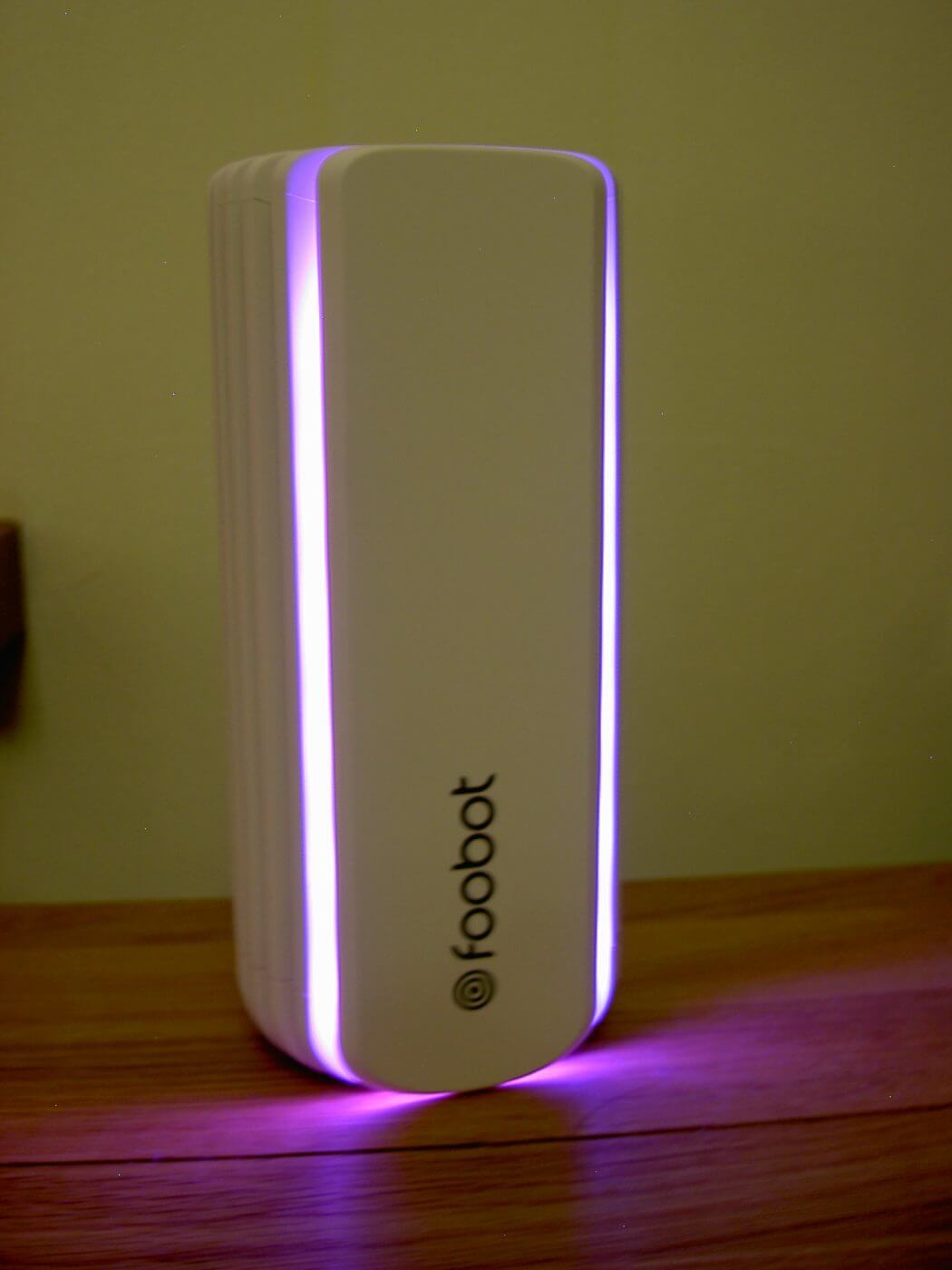
Although light on the detail, the Foobot does colour itself to express air quality based on the GPI – the Global Pollution Index. Information on how it’s calculated is a little sparse though apparently it’s “a weighted compound of the different pollutants measured by Foobot“. Smaller is better, so less than 25 is great, 25-50 is good, 50-75 is fair and 75+ is poor (just move out). The Foobot will glow blue for great and good, and orange for a GPI over 50. The length of the lights is an indicator for how good or bad the GPI is.
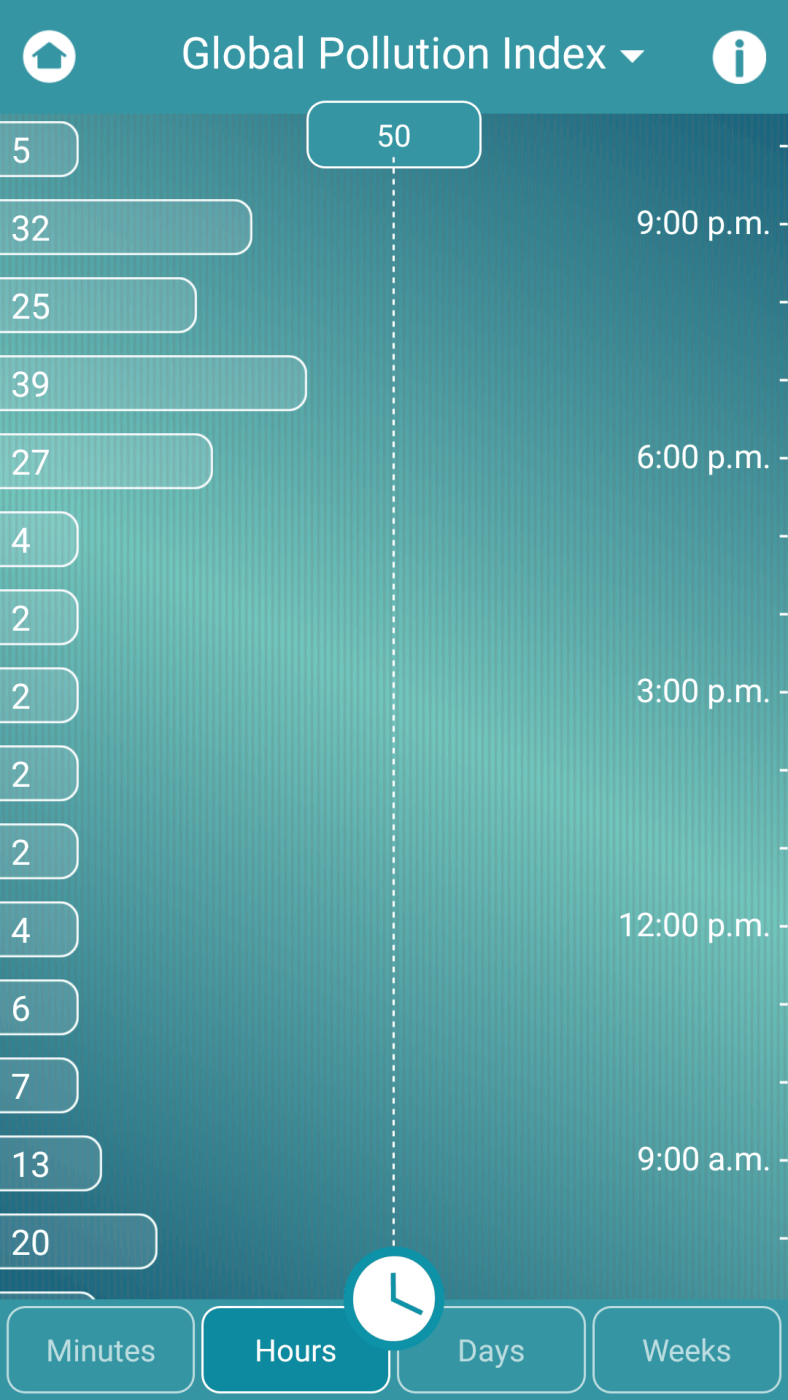
The really juicy stuff is in the smartphone app which is a free download from the relevant app store. To start with, the colour of the app will mimic the Foobot but more detail on the level of Particulate Matter, Volatile Compounds and Carbon Dioxide is available. Humidity and Temperature are shown too. A couple of different views present the information in varying levels of detail.


Swiping up from the bottom shows historical information and swiping left or right moves between the measures. The information is presented by minutes, hours, days or weeks.


The Foobot app supports notifications and if any threshold is breached, sends the app a notfication. Notifications can be individually controlled but the thresholds seem fixed. Here in Northern Ireland it’s fairly damp much of time so the default 60% humidity threshold meant that I got lots of notifications. I turned it off.
Along with the notification, Foobot asks for clarification on what you think might have caused the peak and offers the choice of things like cleaning and cooking. One curious option is “olfactive decorator” which I think translates to “smelly paint”.
The Foobot app has a couple of other settings. The intensity of the LEDs can be adjusted and the LEDs can be put on a timer so that if the Foobot is in, say, a bedroom, they can be timed to go off at night.

What improvements would I like? Two things come to mind….one, for the alert thresholds to be adjustable to allow for damp countries and, second, for there to be a specific detection and alert for carbon monoxide (CO) with the option of alerting multiple people should it be sensed. CO is a dangerous poisonous gas produced by burning gas, wood, propane, charcoal or other fuel that kills people in their sleep. I have a gas-burning stove in my home so I’m always conscious of this risk (yes, I have a CO-detector).
Overall, the Foobot does what it sets out to do – it measures indoor air quality – and if you do have a family member who suffers from a condition affected by air quality I think the Foobot is money well spent. I’ve had the Foobot operational in my home for about two months over the summer and I can already see trends associated with weather and indoor activity such as cooking (or burning!). If you are then able to match trends to symptoms, you are well on the way to better managing the medical condition.
Other scenarios might be if you lived near a busy road or a factory, and were concerned about pollution, or even to keep an eye on an elderly relative without going for the complexity of a whole smart home. The relative could “knock knock” every now and then, and you could make sure he or she is warm enough and not skimping on the heating. Just a thought…
I can’t comment on the accuracy of the VOC and particulate figures, but the humidity and temperature measurements were very similar to the values recorded by other smart sensors. Further, the general trends appeared to be correct – people in the room, vacuuming, opening windows, cooking – all impacted as expected on the measurements, so broadly I believe the figures are correct.
The Foobot is available direct from their website priced at US$199 and EU€199. The Foobot is on Amazon.co.uk too for GB£179.
Thanks to Foobot for supplying the unit for review. There’s an unboxing and review video below.
