
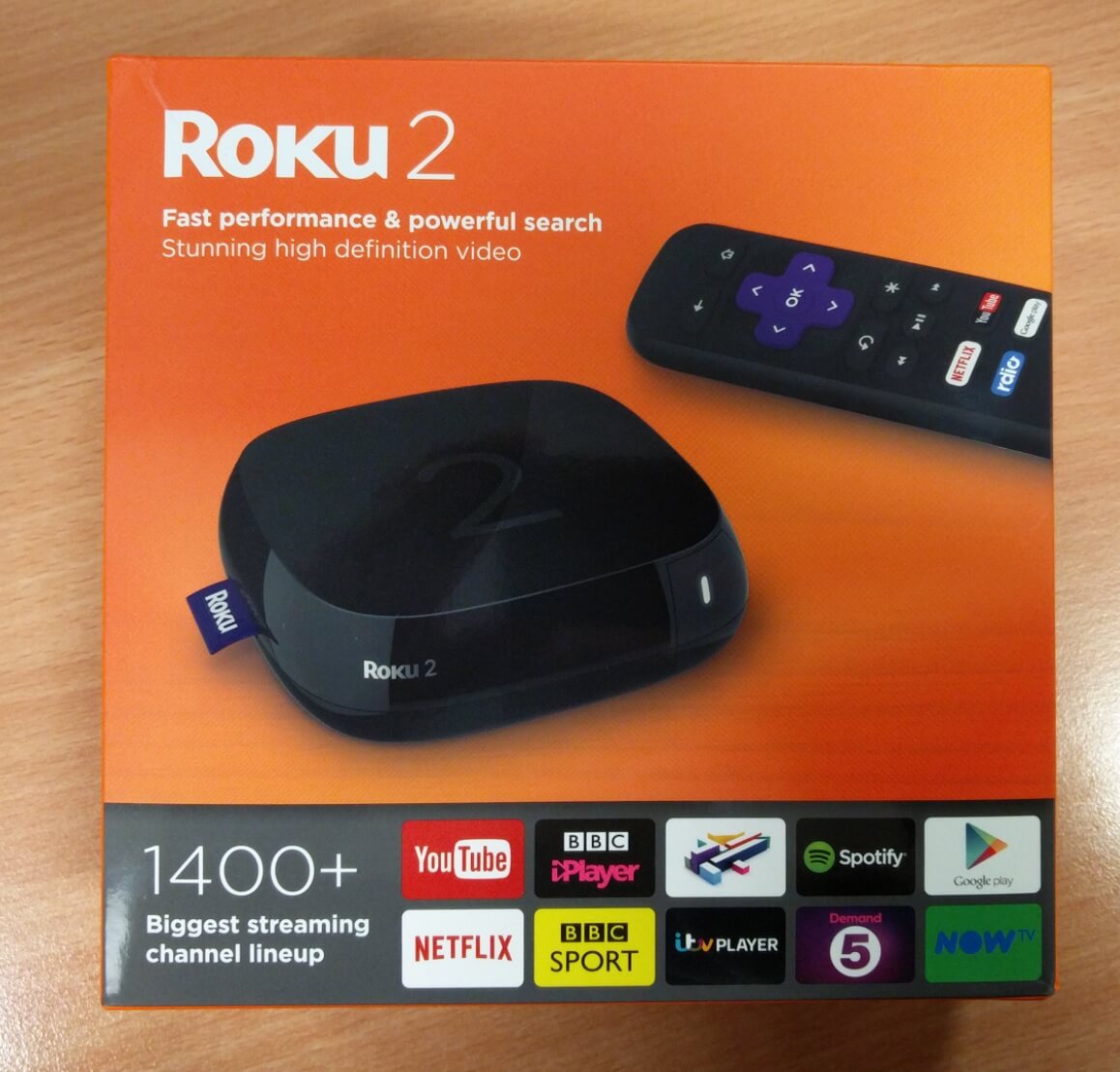
In the box, you get the Roku 2, remote control (with batteries) and power supply with four plug adaptors, including UK, US and continental. There’s no HDMI cable.

As with the previous Roku 2 models, it’s in the “hockey puck” style, though it’s a little bit more rounded than the earlier Roku 2 models. The remote is the usual candy bar, but this model uses IR signal transmission rather than the WiFi and Bluetooth of predecessors. This may be of interest if your Roku normally lives round the back of the TV as you’ll need to bring it into view.

Looking round the 2, there’s the trademark fabric tab on one side, with a USB port on the other. At the back you’ll find HDMI, network and DC power sockets, along with a microSD card slot. In addition to the Ethernet, the Roku 2 has dual band wireless.
Getting started is straightforward. Plug everything into the Roku 2, put the batteries in the remote and sit back on the sofa with the remote. The Roku 2 steps through the setup in a straightforward fashion, though putting in long passwords or WiFi keys can be a bit laborious. Regardless, you can be up and running within minutes.
Roku offers over 1,500 streaming entertainment channels which are great for followers of niche programming, whether travel, sport, kids, health & fitness or faith/religion. However, the vast majority of UK buyers will be interested in the offerings from the main terrestrial broadcasters plus the well known video-on-demand services. Naturally, Roku has them all. BBC iPlayer, ITV Hub, All 4, Demand 5, Sky Now, Netflix, Amazon Prime, Google Play Movies and YouTube. For audio fans, there’s Spotify, Rdio, Pandora, TuneIn and Vevo. Newshounds will like the BBC News and Sky News channels. I could keep going but in summary there’s lots there and no-one will ever be able to say, “There’s nothing on the TV”.

If you’re a real film buff, you’ll be interested in Roku Search and Roku Feed. The former searches through top channels by title, actor or director to find your favourite programming and the Roku Feed automatically updates you when new films become available for streaming (or if the price changes).
The Roku 2’s main user interface is a simple menu driven affair and it’s not nearly as sophisticated as Amazon’s Fire, which combines media from multiple sources. Part of this is because the Roku doesn’t have the integrated cloud-based ecosystem behind it in the style of Amazon or Google, but part is to keep things straightforward and easy to use, much like an ordinary TV. The channels such as Netflix then have their own interface. Frankly, I prefer the channel approach as you know what you are getting, e.g. BBC programming, Netflix’s catalogue, YouTube video. Channel or app sophistication varies hugely. Most are good, especially from the big names like BBC or Netflix, though Spotify’s channel is a bit disappointing.

To play media from smartphones and tablets, Roku offers a complementary app (Android, iOS and Windows) which can be used to not only manage and control the Roku 2, but also cast media from the mobile device to the screen. It’s great to show the photos you’ve just taken on the TV.
There’s no doubt there’s strong competition out there for the spot below your TV but the Roku 2 performed well and without issue. Pricewise, the Roku 2 has an RRP of £69.99 but can be found on-line for £10 less which is good value especially at the lower price. Of course, if you don’t need to play from local storage, consider the Roku Streaming Stick which is £20 cheaper (RRP £49.99). Overall, I think the Roku is a good choice if your intention is to “watch TV” without being distracted by unnecessary features. Go on, get one for Christmas.
Thanks to Roku for providing the Roku 2 for review.