
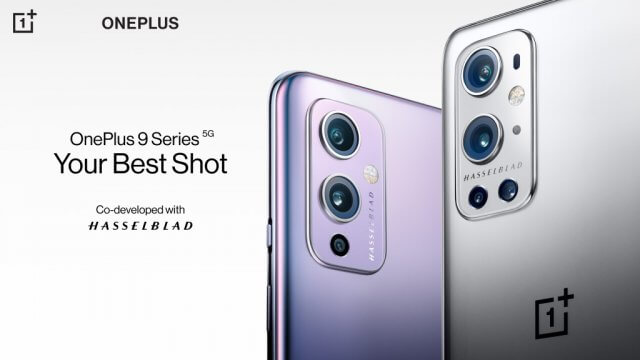


OnePlus’ new partnership with Hasselblad is the most important change for the OnePlus 9 series, bringing Hasselblad’s years of experience to develop Hasselbald’s Camera for Mobile. OnePlus has always been good technically – the OnePlus 8 Pro uses the Sony IMX689 which was specially produced with sister company Oppo and Sony – but has perhaps lacked that extra know-how to take their smartphone cameras from good to great. If you are wondering who Hasselblad are and why they’re special, let’s just say that when NASA wants a camera to go into space or perhaps even go to the moon, they call Hasselblad.
This is a multi-year partnership involving millions of dollars and the deal is for Hasselblad to take OnePlus to the top of the game. The first part will be to get the best from the existing technology, as exemplified in the OnePlus 9 series. The next step will be to design hardware together to get that perfect synchronicity between hardware and software. Hasselblad’s approach is one “Natural Colour Calibration” so the goal is for the image taken by the camera to match the real-world. There’s no artificial enhancement to make colours pop out – the image sees what you see, not what would look best on the ‘Gram.

For the 9, it’s a triple-camera array with a 48 MP IMX689 for the main camera (same as the 8 Pro from last year) but shares the 9 Pro’s IMX766 for the ultra-wide. The third lens is a 2 MP monochrome unit for black-and-white fun. As with 9 Pro, the selfie cam is the same 16 MP Sony sensor. In many respects, the difference between the 9 and 9 Pro’s imaging is much smaller now than it has been in the past. Note the Hasselblad branding.
The camera app on the phones has been enhanced in a couple of ways to emphasise the relationship with Hasselblad. At a gimmick-level, the shutter button is now orange and the shutter noise is that of a Hasselblad camera. More practically, the camera app now has a Pro mode that gives the photographer much greater control over the photograph.
OnePlus’ burdenless design comes to both phones and if in nothing else, it’s reflected the colouring of the camera array to match the back. It’s a small touch but really looks good. In the hand, the OnePlus 9 feels great. The only edge I could notice was that of the screen protector.
While the camera’s the “big deal” in this iteration of OnPlus phones, there have been other improvements almost across the board. Both phones come with the Qualcomm Snapdragon 888 5G CPU, which in my testing gave a Geekbench score of around 1100 for the OnePlus 9, compared with around 900 on the 8. At face value that’s a significant power boost. The CPU is backed up with LPDDR5 RAM and UFS 3.1 memory for storage. Each phone comes with two variants, 8 GB & 128 GB, and 12 GB & 256 GB. Obviously, there’s 5G (3rd gen) connectivity but there’s also Wi-Fi 6, Bluetooth 5.2 and NFC wireless.

For the display, the OnePlus 9 uses the same screen as found in the 8T, so it’s a 6.55″ AMOLED display, 2400 x 1080 pixels giving 402 ppi. It’s broadly a flat screen, so while the front curves gently into the side of the phone, it’s not a curved display itself. The display’s refresh rate is switchable between 60 Hz and 120 Hz which is buttery smooth but at the cost of battery life. Previously the display had been rated A+ by the folks at DisplayMate when it was assessed in the 8T.
However, the OnePlus 9 takes the display technology to a new level, using LTPO (low-temperature polycrystalline oxide) which allows controls of the refresh rate from 1 Hz to 120 Hz. Simplistically the 9 Pro can adjust the display rate to suit the task. Reading a document, reduce the refresh rate down; playing a game, whack it up. Very clever stuff – OnePlus call this FluidDisplay 2.0. In terms of the numbers, it’s a 6.7″ AMOLED with LTPO display, 3216 x 1440 pixels giving an incredible 525 ppi. This screen is curved at the sides, and OnePlus reassures that lessons have been learned and improvements made to avoid ghost touches and colour bleeding.

In one of the few things that hadn’t been leaked, OnePlus announced gaming finger triggers as “coming soon” but there wasn’t much detail – see pic on the left.
Let’s talk pricing….
OnePlus 9
8 GB + 128 GB: US$729 / GB£629 / 699€
12 GB + 256 GB: GB£729 / 799€
OnePlus 9 Pro
8 GB + 128 GB: GB£829 / 899€
12 GB + 256 GB: US$1069 / GB£929 / 999€
Looking back to last year’s prices, there’s been a small bump of about £30 across the range. Pre-orders will open immediately with general availability from 31st March for 9 Pro, followed by the 9 on 26th April.

The round display is a 1.39″ AMOLED display at 326 ppi and is protected by a sapphire glass crystal which is pretty hard. In a cool move, the Watch takes standard watch straps so it’s to switch them out for something more personal.
In addition to pairing and working with a smartphone, the OnePlus Watch acts as remote control for the OnePlus TV, and with about 2 GB of memory, there’s plenty of space for music. Battery life is rated at over 2 weeks (yep, two weeks) and even the most active athlete will get over a week. The Watch uses Warp Charging and about 40 minutes will get it charged up from flat.
The classic edition of the OnePlus watch will be priced at US$159 / GB£149 / 159€. Availability will be announced soon along with pricing for the Cobalt LE.
